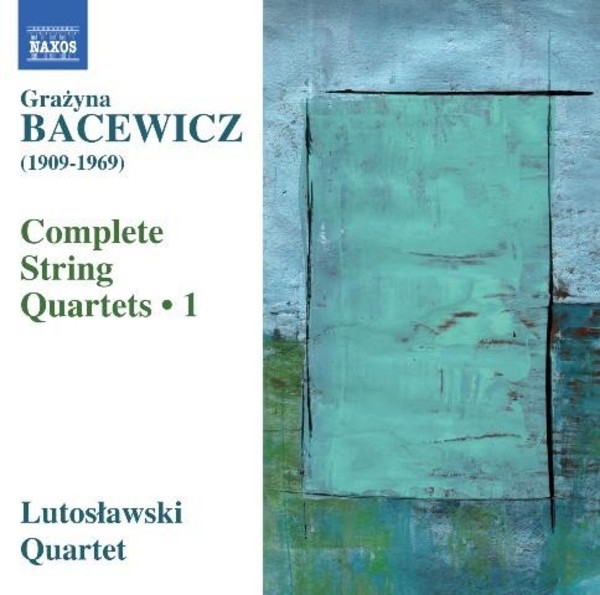
Grazyna Bacewicz - Complete String Quartets Vol.1
£12.30 £9.84
save £2.46 (20%)
special offer ending 25/01/2026
Usually available for despatch within 3-5 working days
Despatch Information
This despatch estimate is based on information from both our own stock and the UK supplier's stock.
If ordering multiple items, we will aim to send everything together so the longest despatch estimate will apply to the complete order.
If you would rather receive certain items more quickly, please place them on a separate order.
If any unexpected delays occur, we will keep you informed of progress via email and not allow other items on the order to be held up.
If you would prefer to receive everything together regardless of any delay, please let us know via email.
Pre-orders will be despatched as close as possible to the release date.
Label: Naxos
Cat No: 8572806
Format: CD
Number of Discs: 1
Genre: Chamber
Release Date: 29th June 2015
Contents
Artists
Lutoslawski QuartetWorks
String Quartet no.1String Quartet no.3
String Quartet no.6
String Quartet no.7
Artists
Lutoslawski QuartetAbout
Musicologist Adrian Thomas considered Grażyna Bacewicz’s string quartets “unrivalled in 20th-century Polish music and… one of the century’s most significant contributions to the genre”.
Her folk-music infused First Quartet dates from student days at the Paris Conservatoire, while exceptional polyphonic skill, intense emotion and playful, high spirits characterize the Third Quartet.
Both the Sixth and Seventh Quartets unite tradition with a strikingly effective and highly personal exploration of progressive contemporary techniques.
As Lutosławski observed, in the “rapidly changing artistic currents” of the times, “it was [Bacewicz’s] music which helped create that atmosphere”.
Sound/Video
Paused
-
1String Quartet no.6 - I. Andante - Vivo
-
2String Quartet no.6 - II. Vivace
-
3String Quartet no.6 - III. Grave
-
4String Quartet no.6 - IV. Dotted Quarter Note = 114
-
5String Quartet no.1 - I. Moderato - piu mosso
-
6String Quartet no.1 - II. Tema con variazioni
-
7String Quartet no.1 - III. Vivo
-
8String Quartet no.3 - I. Allegro ma non troppo
-
9String Quartet no.3 - II. Andante
-
10String Quartet no.3 - III. Vivo
-
11String Quartet no.7 - I. Allegro
-
12String Quartet no.7 - II. Grave
-
13String Quartet no.7 - III. Con vivezza
Europadisc Review
Born in 1909 in the city of Łódź, Bacewicz was a child prodigy on the violin. She studied violin and composition at the Warsaw Conservatoire and, at Szymanowski's prompting, went on to study at the École Normale de Musique in Paris under the legendary Nadia Boulanger (composition) as well as André Touret and Carl Flesch (violin). In the earlier part of her career she was better known as a violinist, becoming leader of the Polish Radio Orchestra (1936–38) and a soloist in her own right. Even at this stage, she was already making her mark as a composer, but from the mid-1950s she devoted herself exclusively to composition. Her output is dominated by works for strings, including no fewer than seven violin concertos and seven string quartets.
Bacewicz's earlier works reflect her training in Paris, and show a natural inclination towards a resilient form of neo-classicism, albeit with a strong lyrical bent and incorporating elements of folk music. Though she spent much of her life living under two totalitarian regimes – the Nazi occupation and post-war Soviet communism – her music retained a basically positive demeanour, quixotic and spiky but with an underlying strength and tenderness. Following the post-Stalin thaw, Bacewicz began exploring more modernist techniques, especially following her exposure to foreign influences at the first Warsaw Autumn festival of 1956.
The works on this first instalment of quartets from Naxos span almost her entire career. The Quartet No.1 (1938) is a student piece, but a confident one whose vivacious neo-classicism rubs shoulders with folk music in the central movement, a set of variations on a Lithuanian folksong (Bacewicz's father, who encouraged her first musical steps, was Lithuanian). The Third Quartet (1947) was composed while on concert tour in Paris, and its airy textures seem to reflect the optimism of the immediate post-war period, above all in the high-spirited rondo finale.
By way of contrast, the Sixth and Seventh Quartets (1960 and 1965) demonstrate Bacewicz's later incorporation of coloristic sound effects and even (in the first movement of the Sixth) twelve-tone serialism. Both are marked by a comprehensive and instinctive understanding of string techniques, and their sure feeling of structure and expressive involvement – as well as the absence of any hint of musical dogma – ensure that these are as engaging as any of her earlier works.
All four quartets are played with tremendous assurance by the Lutosławski Quartet, who are more than equal to Bacewicz's exacting technical demands. Here are musicians on a mission, presenting a hugely compelling case for these unduly neglected and fabulously rewarding works. Second instalment soon, please!
Error on this page? Let us know here
Need more information on this product? Click here