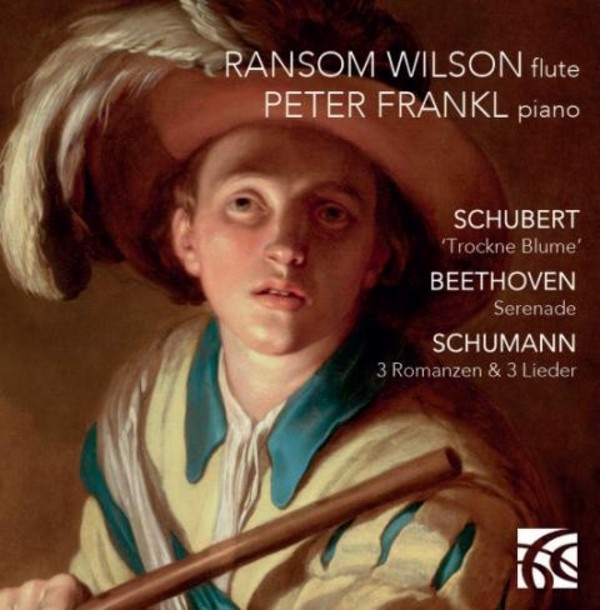
Music for Flute
£13.78
Usually available for despatch within 3-5 working days
Despatch Information
This despatch estimate is based on information from both our own stock and the UK supplier's stock.
If ordering multiple items, we will aim to send everything together so the longest despatch estimate will apply to the complete order.
If you would rather receive certain items more quickly, please place them on a separate order.
If any unexpected delays occur, we will keep you informed of progress via email and not allow other items on the order to be held up.
If you would prefer to receive everything together regardless of any delay, please let us know via email.
Pre-orders will be despatched as close as possible to the release date.
Label: Nimbus - Alliance
Cat No: NI6309
Format: CD
Number of Discs: 1
Genre: Chamber
Release Date: 1st June 2015
Contents
Works
Serenade in D major for flute and piano (arrangement of op.25), op.41Introduction and Variations on 'Trockne Blumen' from 'Die schone Mullerin', op.160 D802
Gedichte (6) und Requiem, op.90
Spanische Liebeslieder, op.138
Artists
Ransom Wilson (flute)Peter Frankl (piano)
Works
Serenade in D major for flute and piano (arrangement of op.25), op.41Introduction and Variations on 'Trockne Blumen' from 'Die schone Mullerin', op.160 D802
Gedichte (6) und Requiem, op.90
Spanische Liebeslieder, op.138
Artists
Ransom Wilson (flute)Peter Frankl (piano)
About
Franz Schubert’s only significant work for flute is an offshoot of his famous song-cycle 'Die schöne Müllerin', completed in November 1823. In January 1824 he took the melody of the 18th song, ‘Trockne Blumen’ (Faded Flowers) and made it the basis of his Introduction and Variations in E minor on ‘Trockne Blumen’ for flute and piano. It may have been composed for Schubert’s friend Ferdinand Bogner, a professor of flute at the Vienna Conservatory, but it remained unpublished – and perhaps unperformed – until 1850, when the work was issued posthumously as Schubert’s op.160. Since then it has formed an essential part of the flute repertoire.
Beethoven’s only mature and substantial contribution to the instrument’s repertoire is the Serenade, op.25 for flute, violin and viola, written in 1801. In 1803, the Bohemian composer Franz X Kleinheinz (1772-1832), who had recently arrived in Vienna to study with Beethoven’s old teacher Albrechtsberger, arranged this work for flute (or violin) and piano. The arrangement was obviously carried out with Beethoven’s full approval, as he is known to have checked it over and sanctioned it before it was printed in December, 1803.
Robert Schumann wrote no original pieces for flute. However, it is but a small leap for flautists to include the 3 Romanzen op.94 in their repertoire. They were written in 1849, for oboe, but with the composer’s indication that they were suitable for either clarinet or violin. The Romanzen are simply ‘Songs without Words’, and as such open to all instrumental colours equally.
Ransom Wilson has long been recognized internationally as one of the greatest flutists of his generation. After graduation from the Juilliard School in 1973, he spent a year in Paris as a private student of Jean-Pierre Rampal. In 1976 he gave his official debut concert in New York City, with Rampal as his guest artist. An exclusive recording contract with Angel/EMI followed soon after, along with extensive performances all over the world.
Ransom Wilson is an Artist of the Chamber Music Society of Lincoln Center, Professor of Flute at Yale University, Conductor at Suny Purchase, Assistant Conductor at the Metropolitan Opera, Artistic Director of Le Train Bleu ensemble, Music Director of the Lar Lubovitch Dance Company, and Artistic Director of the NY State Summer School of the Arts, School of Orchestral Studies.
Error on this page? Let us know here
Need more information on this product? Click here