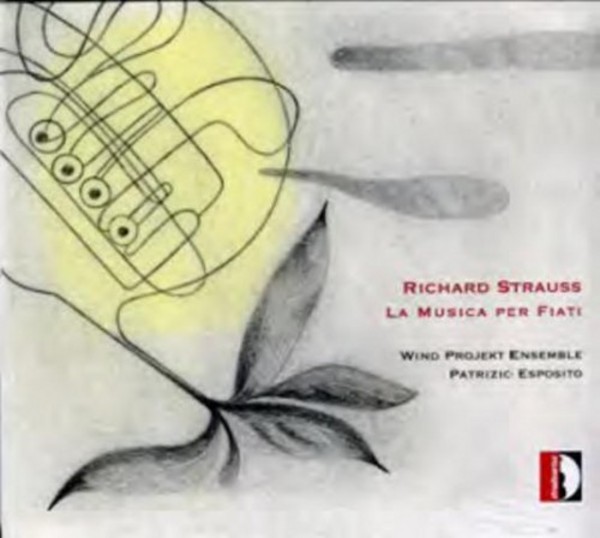
R Strauss - Music for Wind Instruments
£15.15
Usually available for despatch within 3-5 working days
Despatch Information
This despatch estimate is based on information from both our own stock and the UK supplier's stock.
If ordering multiple items, we will aim to send everything together so the longest despatch estimate will apply to the complete order.
If you would rather receive certain items more quickly, please place them on a separate order.
If any unexpected delays occur, we will keep you informed of progress via email and not allow other items on the order to be held up.
If you would prefer to receive everything together regardless of any delay, please let us know via email.
Pre-orders will be despatched as close as possible to the release date.
Label: Stradivarius
Cat No: STR37014
Format: CD
Number of Discs: 1
Genre: Chamber
Release Date: 1st June 2015
Contents
Works
Sonatina no.1 in F major for 16 wind instruments 'Aus der Werkstatt eines Invaliden', AV135Sonatina no.2 in E flat major for 16 wind instruments, AV143 'Frohliche Werkstatt'
Artists
Wind Projekt EnsembleConductor
Patrizio EspositoWorks
Sonatina no.1 in F major for 16 wind instruments 'Aus der Werkstatt eines Invaliden', AV135Sonatina no.2 in E flat major for 16 wind instruments, AV143 'Frohliche Werkstatt'
Artists
Wind Projekt EnsembleConductor
Patrizio EspositoAbout
An ‘Indian summer’: by general agreement that is how music historians today describe Richard Strauss’s final creative period, one extending from 1942 until his death in 1949. In the warmth of that unexpected ‘summer’, the elderly composer – by then in his 80s – brought into being masterpieces such as the 'Metamorphosen' for 23 solo strings and the 'Vier letzte Lieder' for soprano and orchestra. And, alongside those works, he also produced the two Sonatinas for winds, in F major and E flat major.
In the Imperial Germany of the decades bridging the two centuries, Strauss had been regarded as a composer of the very front rank, but he had seen his fame diminish considerably during the Weimar Republic of the 1920s. On the one hand, his works were no longer accorded the triumphant receptions of the pre-War period; on the other, his rejection of the more advanced musical idioms, after the harsh sonorities of his operas 'Salome' (1905) and 'Elektra' (1909), had isolated him from the younger generations of composers, who ceased to look up to him as a role model.
Strauss used to call the works of the present recording “superfluous music” - in other words, simple exercises both for himself as a composer and for performers wishing to improve their ensemble technique. But in spite of his own modest claim about their worth, he plainly took a lot of trouble over their composition. We not only find continuous motivic interplay, even in dense contrapuntal combinations, but also notice that in both works he connects the first and last movements through clearly identifiable thematic elements.
Error on this page? Let us know here
Need more information on this product? Click here