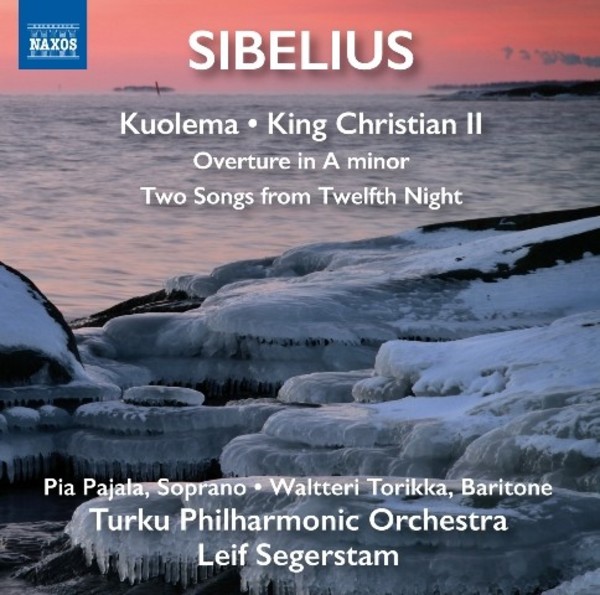
Sibelius - Kuolema, King Christian II, etc
£12.30 £9.84
save £2.46 (20%)
special offer ending 25/01/2026
Usually available for despatch within 3-5 working days
Despatch Information
This despatch estimate is based on information from both our own stock and the UK supplier's stock.
If ordering multiple items, we will aim to send everything together so the longest despatch estimate will apply to the complete order.
If you would rather receive certain items more quickly, please place them on a separate order.
If any unexpected delays occur, we will keep you informed of progress via email and not allow other items on the order to be held up.
If you would prefer to receive everything together regardless of any delay, please let us know via email.
Pre-orders will be despatched as close as possible to the release date.
Label: Naxos
Cat No: 8573299
Format: CD
Number of Discs: 1
Release Date: 1st June 2015
Contents
Works
King Kristian II, op.27: Incidental MusicKuolema (Death): incidental music to the play by Arvid Jarnefelt, JS113
Overture in A minor, JS144
Songs (2) from Shakespeare's 'Twelfth Night', op.60
Artists
Pia Pajala (soprano)Waltteri Torikka (baritone)
Turku Philharmonic Orchestra
Conductor
Leif SegerstamWorks
King Kristian II, op.27: Incidental MusicKuolema (Death): incidental music to the play by Arvid Jarnefelt, JS113
Overture in A minor, JS144
Songs (2) from Shakespeare's 'Twelfth Night', op.60
Artists
Pia Pajala (soprano)Waltteri Torikka (baritone)
Turku Philharmonic Orchestra
Conductor
Leif SegerstamAbout
Jean Sibelius was the most significant figure in the formation of Finland’s musical identity. Beyond the famous symphonies and tone poems he was prolific in other genres, including music for the theatre.
King Christian II and Kuolema ensured Sibelius’s fame throughout Europe, the latter including the haunting melody which would later become the Valse triste. The Two Songs from Twelfth Night contrast the spectre of death with more comical moods, an effect is also to be heard in one of Sibelius’s least performed orchestral works, the Overture in A minor.
This is the first of a six volume set of orchestral works by Jean Sibelius which sets out to explore his prolific output beyond the core oeuvre of the symphonies and violin concerto. We are delighted to have conductor Leif Segerstam at the helm of this project. Acclaimed for his many recordings with numerous orchestras, Segerstam was awarded the annual Finnish State Prize for Music in 2004, and in 2005 the highly esteemed Sibelius Medal.
With the platinum record making and award winning Turku Philharmonic as its superbly firm bedrock, this new recording of Sibelius also presents baritone Waltteri Torikka, one of the most promising new talents in the next generation of opera singers from Finland and named Young Musician of the Year 2014 by the Finnish Pro Musica Foundation. Soprano Pia Pajala is a versatile performer known for her wide vocal range, powerful expression and strong interpretations of Sibelius and Finnish classical music.
Sound/Video
Paused
-
1Overture in A minor
-
2Kuolema - I. Tempo di valse lente - poco risoluto
-
3Kuolema - II. Moderato
-
4Kuolema - III. Moderato assai - moderato
-
5Kuolema - IV. Andante
-
6Kuolema - V. Moderato
-
7Kuolema - VI. Andante ma non tanto
-
8Twelfth Night - I. Come Away, Death
-
9Twelfth Night - II. Hey, Ho, the Wind and the Rain
-
10King Christian II - I. Elegy
-
11King Christian II - II. Musette
-
12King Christian II - III. Menuetto
-
13King Christian II - IV. Fool's Song of the Spider
-
14King Christian II - V. Nocturne
-
15King Christian II - VI. Serenade
-
16King Christian II - VII. Ballade
Europadisc Review
This first disc sets enviably high standards, and focuses on Sibelius's two earliest sets of incidental music, to Adolf Paul's historical drama King Christian II (1898) and Arvid Järnefelt's symbolist play Kuolema (Death, 1903). The disc kicks off, however, with one of Sibelius's least performed orchestral works, the Overture in A minor of 1902. It was composed – by some accounts, in a single night – for the concert at which the Second Symphony received its première. While clearly not among the composer's greatest works, the Overture sets up a nice contrast between the imposing brass fanfares of the outer sections and the lighter central episode, where the string and woodwind writing anticipates the first movement of the Third Symphony, and the performance itself is splendidly atmospheric.
Kuolema follows the life of the young Paavali, from the death of his mother in Act I, through his wanderings and encounter with the mysterious Elsa, whom he marries, to his own death years later, beckoned by the spirit of his departed mother. The music is scored almost entirely for strings alone, and the first number is easily the best known, for this is none other than the Valse triste in its original theatrical context, as dancers beckon Paavali's ailing mother to her death. Here it receives a hauntingly tender performance, and both the original scoring and the segue ending will come as a nice surprise to those who know the work in its more famous form. Other highlights are the wintry 'Paavali's Song', superbly sung by baritone Waltteri Torikka, 'Elsa's Song' (a fine cameo from soprano Pia Pajata) and the following number ('The Cranes'), which were later combined by Sibelius as the Scene with Cranes (1906). In the final movement, a delicate carpet of string sound gives way to the chime of funeral bells.
Waltteri Torikka takes centre stage in the Two Songs from Twelfth Night of 1909, in Carl August Hagberg's Swedish translation. Feste's 'Come away, come away, death' and 'When that I was and a little tiny boy' make a well contrasted pairing, and were originally scored by Sibelius for baritone and either guitar or piano. In 1957, as the end of his own life approached, Sibelius orchestrated 'Come away', and both the scoring and this performance are searingly evocative. 'When that I was' is heard in an imaginative orchestration by the distinguished Finnish bass Kim Borg (1919–2000).
The story of King Christian II revolves around the 16th-century Scandinavian monarch's love for a humble Dutch girl, Dyveke Sigbritsdatter. This is the earliest music on the disc, but it shows an already assured touch and deep sensitivity, even in the more sparsely scored first four numbers, which include a moving Elegy, an attractive Musette for pairs of clarinets and bassoons, and the 'Fool's Song of the Spider', with Torikka making his final appearance. Sibelius subsequently added a further three movements – Nocturne, Serenade and Ballade – with expanded orchestration and dimensions, more redolent of his mature style, and the whole set is performed with great commitment and feeling.
This disc is worth the price just to hear Torikka's idiomatically engaging singing, but Segerstam's unfailingly sensitive conducting and the Turku Philharmonic's polished playing make the prospect of further releases in the series a mouthwatering one.

Error on this page? Let us know here
Need more information on this product? Click here