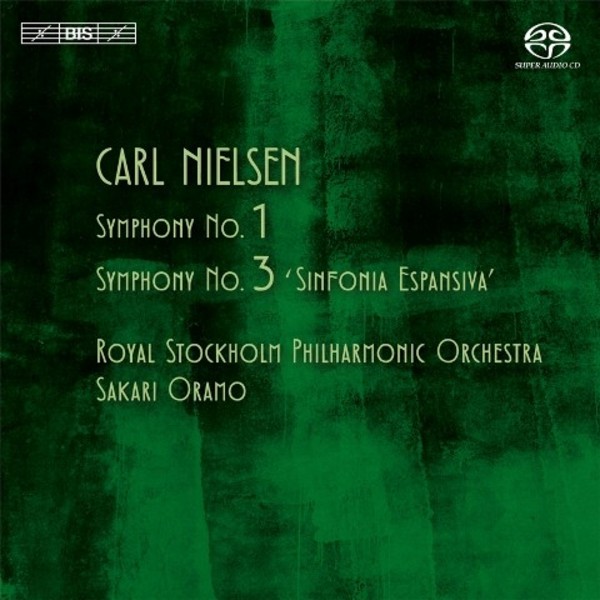
Nielsen - Symphonies Nos 1 & 3
£14.73 £11.78
save £2.95 (20%)
special offer ending 25/01/2026
In stock - available for despatch within 1 working day
Despatch Information
This despatch estimate is based on information from both our own stock and the UK supplier's stock.
If ordering multiple items, we will aim to send everything together so the longest despatch estimate will apply to the complete order.
If you would rather receive certain items more quickly, please place them on a separate order.
If any unexpected delays occur, we will keep you informed of progress via email and not allow other items on the order to be held up.
If you would prefer to receive everything together regardless of any delay, please let us know via email.
Pre-orders will be despatched as close as possible to the release date.
Label: BIS
Cat No: BIS2048
Format: Hybrid SACD
Number of Discs: 1
Genre: Orchestral
Release Date: 5th January 2015
Contents
Artists
Royal Stockholm Philharmonic OrchestraConductor
Sakari OramoWorks
Symphony no.1 in G minor, op.7Symphony no.3, op.27 'Sinfonia espansiva'
Artists
Royal Stockholm Philharmonic OrchestraConductor
Sakari OramoAbout
The first volume of this new cycle was widely acclaimed upon its release in December 2013 (BIS2028).
Symphony No.1 owes much to Schumann and was completed in 1892, when the composer was still in his mid-twenties.
Symphony No.3 was the true breakthrough work, following twenty years after the first symphony and rapidly taken up by Europe’s leading orchestras.
Sound/Video
Paused
-
1Symphony no.1 in G minor - I. Allegro orgoglioso
-
2Symphony no.1 in G minor - II. Andante
-
3Symphony no.1 in G minor - III. Allegro comodo - andante sostenuto - Tempo I
-
4Symphony no.1 in G minor - IV. Finale. Allegro con fuoco
-
5Symphony no.3 'Sinfonia Espansiva' - I. Allegro espansivo
-
6Symphony no.3 'Sinfonia Espansiva' - II. Andante pastorale
-
7Symphony no.3 'Sinfonia Espansiva' - III. Allegretto un poco
-
8Symphony no.3 'Sinfonia Espansiva' - IV. Finale. Allegro
Europadisc Review
This second disc is a worthy successor. The First and Third symphonies lack the dark undertones of the Fourth and Fifth, and there's a wonderfully open quality to these latest performances. In the First Symphony, Nielsen's remarkably assured first complete essay in the genre, this sense of openness is helped by antiphonally divided violins, which bring textural clarity to what can, in some performances, seem congested tutti passages. In a finely balanced recording from the Stockholm Concert Hall, each section of the orchestra emerges well-lit, not least the splendidly alert woodwind.
In the Andante second movement there are some piercingly beautiful oboe solos, and the music swells with a feeling of inevitability to imposing brass-dominated (but not overpowered) tuttis. The formal layout is fairly conservative, Nielsen still showing the influence of such figures as Schumann and Mendelssohn, and Oramo is careful to observe all repeats. Unexpectedly for a work in G minor, the Finale settles into C major, an early (1891) symphonic example of ‘progressive tonality'. Here the coda is particularly exultant, a thrilling close to a fascinating work.
The Third Symphony of 1910–11 represents the fully mature Nielsen, and his title for the work – Sinfonia espansiva – is closely bound up with what he described as the ‘burst of energy and life-affirmation' thrown out by the opening movement. This is a powerfully animated triple-time Allegro espansivo which stands as a direct successor to three earlier ‘Thirds': Beethoven's ‘Eroica', Schumann's ‘Rhenish' and Brahms's Third. Oramo's performance has all the classical acuity and incisiveness one would expect for a work of such a pedigree, and the big tune at the first movement's mid-point (05:56) swings along with tremendous élan.
The Andante pastorale second movement starts with beautifully sustained unison horns and strings, hinting at a rolling landscape dotted with woodwind solos, before a richly harmonised string theme makes its first entrance. A wordless solo baritone and soprano (finely sung here by Karl-Magnus Fredriksson and Anu Komsi) add to the feeling of an ecstatic pastoral idyll. In the following Allegretto the brilliant Stockholm woodwind have another chance to shine; fugato sections are bitingly clear, and the big antiphonal tutti at 04:33 is spine-tinglingly exciting.
In Oramo's hands, the opening theme of the Finale is a thrillingly noble, broad, generous and – yes – expansive affair, the orchestral voices keenly balanced to highlight the majestic tenor register. The ebb and flow of the music do nothing to undermine the music's positive demeanour, and the coda is as overwhelming as it is uplifting, fully justifying this work's status as Nielsen's breakthrough symphony.
With demonstration-quality recording, and excellent notes by Nielsen expert David Fanning, this disc reinforces the claims for Oramo and his Stockholm to be placed at the top of the pile. Heartily recommended!
Error on this page? Let us know here
Need more information on this product? Click here