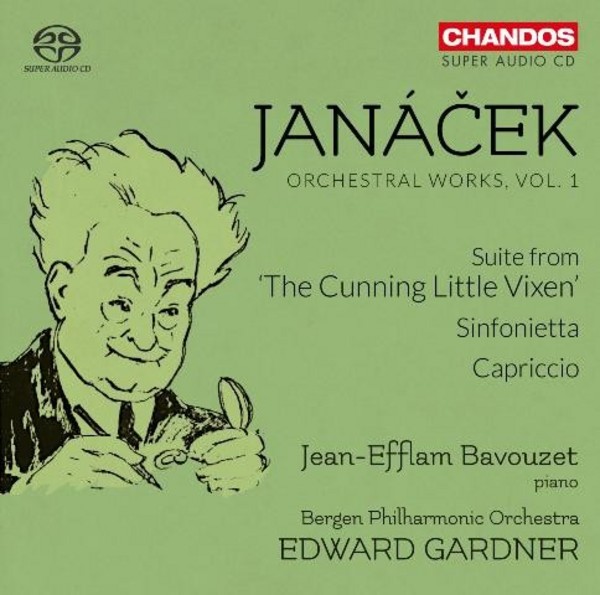
Janacek - Orchestral Works Vol.1
£15.15 £9.09
save £6.06 (40%)
special offer ending 01/01/2026
In stock - available for despatch within 1 working day
Despatch Information
This despatch estimate is based on information from both our own stock and the UK supplier's stock.
If ordering multiple items, we will aim to send everything together so the longest despatch estimate will apply to the complete order.
If you would rather receive certain items more quickly, please place them on a separate order.
If any unexpected delays occur, we will keep you informed of progress via email and not allow other items on the order to be held up.
If you would prefer to receive everything together regardless of any delay, please let us know via email.
Pre-orders will be despatched as close as possible to the release date.
Label: Chandos
Cat No: CHSA5142
Format: Hybrid SACD
Number of Discs: 1
Genre: Orchestral
Release Date: 29th September 2014
Contents
Works
Capriccio for piano (left hand) and chamber ensemble, 'Vzdor', JW VII/12Sinfonietta
The Cunning Little Vixen: Suite
Artists
Bergen Philharmonic OrchestraJean-Efflam Bavouzet (piano)
Conductor
Edward GardnerWorks
Capriccio for piano (left hand) and chamber ensemble, 'Vzdor', JW VII/12Sinfonietta
The Cunning Little Vixen: Suite
Artists
Bergen Philharmonic OrchestraJean-Efflam Bavouzet (piano)
Conductor
Edward GardnerAbout
Edward Gardner conducts the Bergen Philharmonic Orchestra in the opening volume in their series devoted to orchestral works by Leoš Janácek. It features three pieces that originate in Janácek’s late period, when his passionate feelings for Kamila Stösslová, thirty-seven years his junior, inspired an extraordinary flowering of his creative genius.
The Sinfonietta is one of Janácek’s most successful and popular works, famed for its opening movement, a brazen fanfare scored for a phalanx of brass with timpani. The remaining four movements, full of character, celebrate Janácek’s adopted town of Brno, blending occasional reflection with high-voltage exuberance.
Scored unusually for left-hand piano and an ensemble of brass and flute, the Capriccio is remarkable even among Janácek’s distinctive late works. Its overall effect is mercurial and capricious, in the composer’s words: ‘whimsical, all wilfulness and witticisms’. Jean-Efflam Bavouzet employs his formidable technique and interpretative flair in the solo part.
The Cunning Little Vixen, Janácek’s opera from 1923, was not universally well received at first. A number of its orchestral interludes, however, were immediately popular and after Janácek’s death in 1928 Václav Talich, a leading Czech conductor, extracted an orchestral suite, re-orchestrated by two young colleagues. Recently Sir Charles Mackerras restored Janácek’s striking original orchestration, the version recorded here.
Sound/Video
Paused
-
1Sinfonietta - I. Allegretto
-
2Sinfonietta - II. Andante
-
3Sinfonietta - III. Moderato
-
4Sinfonietta - IV. Allegretto
-
5Sinfonietta - V. Andante con moto
-
6Capriccio - I. Allegro
-
7Capriccio - II. Adagio
-
8Capriccio - III. Allegretto
-
9Capriccio - IV. Andante
-
10The Cunning Little Vixen Suite - I. The Forest
-
11The Cunning Little Vixen Suite - II. The Vixen...
Europadisc Review
By some distance Janáček’s most popular work, the Sinfonietta (1926) is full of the spirit of the newly-independent Czechoslovakia, and Janáček even appended subtitles to the individual movements, associating them with locations in his adopted home town of Brno. The opening brass fanfares (inspired by a real-life military band) and the second movement (the Castle) have tremendous bite in this performance, but also plenty of body, with Gardner and his musicians effortlessly negotiating the score’s frequent speed changes. There’s detail aplenty too, with the tricky harp part emerging with commendable clarity. The opening of the third movement (the Queen’s Monastery) is as evocative as one could wish, while the animated middle section is whipped up to a thrilling climax, with some nice trombone solos en route. There’s a splendidly earthy robustness to the fourth movement (the Street), without ever tripping over into vulgarity, while the final movement (the Town Hall) moves from the soulful opening flute theme via some highly accomplished woodwind solos to the shattering brass peroration with all the inexorability of a fully-fledged symphonic finale. It’s all pulled off with the greatest aplomb, the speeds and balance expertly judged, and the playing of the Bergen players is a joy throughout.
The Capriccio, also from 1926, had its origins in a request from the pianist Otakar Hollmann (who had lost his right arm in the Great War) for a ‘substantial work for piano left hand and chamber orchestra’. Janáček didn’t immediately take to the idea, but the result is one of his most unusual pieces, quirky, mercurial and capricious, for the unlikely combination of piano, flute/piccolo, two trumpets, three trombones and tenor tuba. In his private correspondence, Janáček gave the work a subtitle, Vzdor (Defiance), and it’s an apt one for a work that’s built around such a determinedly unorthodox scoring. The brass instruments lend an edginess to the piano’s innate lyricism, while the flute (doubling on piccolo) brings the sort of registral contrast that is such a hallmark of late Janáček. In very different music from the Sinfonietta, the wind players are really on their mettle, and so is pianist Jean-Efflam Bavouzet, combining sensitivity and suppleness to demonstrate why he is one of today’s most acclaimed soloists. Listen to the magical simplicity he brings to the opening of the second movement (track 7), or the way he entwines with the flute at the outset of the fourth, which builds to one of Janáček’s most unexpectedly ecstatic conclusions. This is as compelling an account of this music as there’s been for a very long while.
Rounding off proceedings (and receiving top billing on the cover and in John Tyrrell’s excellent and detailed booklet notes) is the Cunning Little Vixen Suite. Essentially an orchestral abridgement of Act 1 of the 1924 opera, it tells of the capture of the young Vixen by the Gamekeeper, her yearning for freedom, and her bold escape from his farmyard. It was prepared after Janáček’s death by the conductor Václav Talich with the aim of bringing some of the composer’s most engaging music to wider audiences. Unfortunately Talich felt that Janáček’s highly original orchestration needed some ‘help’ and had it comprehensively re-orchestrated by two younger colleagues. The late Sir Charles Mackerras did the Suite an enormous service by restoring Janáček’s original scoring from the opera itself, and the results are vividly brought to life here by the Bergen orchestra, and Gardner’s experience as an opera conductor is in constant evidence in a performance that is as surely paced and involving as the opera itself is.
This is a hugely promising start to what should be an enthralling series of discs. Next year Gardner becomes the Bergen Philharmonic’s chief conductor: on the evidence of this recording, it will be a fascinating and rewarding partnership.
Error on this page? Let us know here
Need more information on this product? Click here