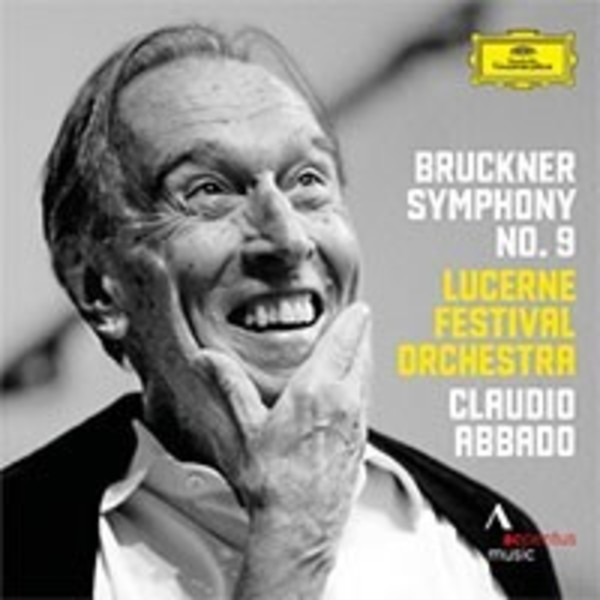
Bruckner - Symphony No.9
£12.83
Usually available for despatch within 5-8 working days
Despatch Information
This despatch estimate is based on information from both our own stock and the UK supplier's stock.
If ordering multiple items, we will aim to send everything together so the longest despatch estimate will apply to the complete order.
If you would rather receive certain items more quickly, please place them on a separate order.
If any unexpected delays occur, we will keep you informed of progress via email and not allow other items on the order to be held up.
If you would prefer to receive everything together regardless of any delay, please let us know via email.
Pre-orders will be despatched as close as possible to the release date.
Label: Deutsche Grammophon
Cat No: 4793441
Format: CD
Number of Discs: 1
Genre: Orchestral
Release Date: 7th July 2014
Contents
Artists
Lucerne Festival OrchestraConductor
Claudio AbbadoAbout
In January 2014, music lovers worldwide were saddened to learn that Claudio Abbado had passed away.
Deutsche Grammophon feels immensely blessed and proud to be releasing, together with Accentus Music, Bruckner’s Symphony No.9 in D Minor, which was recorded as part of Abbado’s final concert.
The concert received very positive reviews from the press:
“Mr. Abbado led an otherworldly account of Bruckner's 9th Symphony. Never have I heard as magisterial and moving performance of the work as that given by the 80-year-old maestro and his fabulous Lucerne Festival Orchestra.” - Wall Street Journal
The concert was recorded by Accentus Music during the 75th Lucerne Festival in 2013 with the Lucerne Festival Orchestra.
This release is a fitting tribute to an irreplaceable artist, who was one of the greatest conductors and most inspiring musical figures of our time.
--
The Europadisc Review
When Claudio Abbado died on 20 January 2014, there was a sense of loss in the classical music world that has rarely been equalled. Although his performances and recordings had always ranked among the best of his generation, following his life-changing diagnosis with cancer in 2000 and subsequent surgery there was a new depth to his music-making which had musicians, audiences and critics alike reaching for superlatives. In particular, his late work with the handpicked Lucerne Festival and the Orchestra Mozart was universally garlanded with laurels, their concerts all sell-out events.
Happily, such was the admiration for Abbado's late forays into the concert hall that all his appearances were recorded, and so his August 2013 performances with the Lucerne Festival Orchestra in what were to be his final concerts have been preserved for posterity. They brought together two great symphonic torsos: Schubert's 'Unfinished' Symphony and Bruckner's Ninth – an ideal coupling that was also a feature of Günter Wand's long Indian summer. Now Accentus Music and Deutsche Grammophon have come together to release the Bruckner, and what a performance it is.
Abbado's earliest Bruckner recording was of the First Symphony, on a 1969 LP for Decca with the Vienna Philharmonic, in a work that was evidently a personal favourite; he later re-recorded it with the same orchestra, together with the Fourth, Fifth, Seventh and Ninth, for Deutsche Grammophon. Most recently, and after many years of exploring Mahler's symphonies in ever greater depth with the Lucerne Festival Orchestra, he finally returned to Bruckner in Lucerne with the Fifth and First symphonies, performances that excelled his earlier accounts both in technical accomplishment and expressive range. This new Ninth, however, surpasses them all.
There have been many great performances of this towering work over the years, from Walter, Van Beinum and Jochum to Giulini, Bernstein and Wand, to name but a few. They range from the volatile and urgent to the numinously transcendent, but few come as close to capturing the totality of this cosmic masterpiece as fully as Abbado in this recording.
The hushed opening doesn't so much start as emerge into consciousness: the double basses, who are alone in sustaining their low D while the other strings play a hushed tremolo, act as harbingers of things to come. There's an unforced unanimity to this music-making that carries all before it. Abbado never hurries the music, but there's always a palpable sense of momentum, an awareness of the 'long line' even while the every detail of Bruckner's score is carefully observed. The mighty first movement has just the right amount of drive (this is, after all, essentially a symphonic Allegro, not a slow movement), while the dynamic range, vast as it is, never feels artificially exaggerated.
The Scherzo is powerful and demonic yet fleet-footed and beautifully transparent, bringing the Lucerne orchestra's remarkable woodwind section to the fore. There's a pleasing edginess to the string tone that imparts an urgency to proceedings even though the basic pulse is steady, while the oasis-like Trio has a hallucinatory lightness to it.
Words alone fail to convey the immense power of the great Adagio. The tuttis are resplendent, the strings searingly intense, yet there's also a sense of quiet acceptance (and not just in the closing pages) that makes this performance a uniquely moving one. The climactic triple-forte crunch chord is stark yet short, Abbado quite rightly observing that it's the following rest that has the fermata over it, not the chord itself. It's a moment of shattering bleakness, which finds consolation in the exquisite coda. Particularly special is the way that Abbado lets the final chord of each movement hang in the air, resonating through the hall. It's a measure of the care he takes over both detail and sonic impact.
This is the most lovingly fastidious Ninth since Giulini's famous DG performance, and though the playing is of an almost superhuman excellence, it's shot through with a humanity that Karajan, for example, lacked. Abbado's last performance emerges as very probably the finest and most transcendent of all Bruckner Ninths. But words are inadequate before such greatness: listen for yourself!
Sound/Video
Paused
-
1Symphony no.9 - I. Feierlich. Misterioso.
-
2Symphony no.9 - II. Scherzo (Bewegt) - Trio (Schnell)
-
3Symphony no.9 - III. Adagio (Langsam, Feierlich)
Europadisc Review
Happily, such was the admiration for Abbado's late forays into the concert hall that all his appearances were recorded, and so his August 2013 performances with the Lucerne Festival Orchestra in what were to be his final concerts have been preserved for posterity. They brought together two great symphonic torsos: Schubert's 'Unfinished' Symphony and Bruckner's Ninth – an ideal coupling that was also a feature of Günter Wand's long Indian summer. Now Accentus Music and Deutsche Grammophon have come together to release the Bruckner, and what a performance it is.
Abbado's earliest Bruckner recording was of the First Symphony, on a 1969 LP for Decca with the Vienna Philharmonic, in a work that was evidently a personal favourite; he later re-recorded it with the same orchestra, together with the Fourth, Fifth, Seventh and Ninth, for Deutsche Grammophon. Most recently, and after many years of exploring Mahler's symphonies in ever greater depth with the Lucerne Festival Orchestra, he finally returned to Bruckner in Lucerne with the Fifth and First symphonies, performances that excelled his earlier accounts both in technical accomplishment and expressive range. This new Ninth, however, surpasses them all.
There have been many great performances of this towering work over the years, from Walter, Van Beinum and Jochum to Giulini, Bernstein and Wand, to name but a few. They range from the volatile and urgent to the numinously transcendent, but few come as close to capturing the totality of this cosmic masterpiece as fully as Abbado in this recording.
The hushed opening doesn't so much start as emerge into consciousness: the double basses, who are alone in sustaining their low D while the other strings play a hushed tremolo, act as harbingers of things to come. There's an unforced unanimity to this music-making that carries all before it. Abbado never hurries the music, but there's always a palpable sense of momentum, an awareness of the 'long line' even while the every detail of Bruckner's score is carefully observed. The mighty first movement has just the right amount of drive (this is, after all, essentially a symphonic Allegro, not a slow movement), while the dynamic range, vast as it is, never feels artificially exaggerated.
The Scherzo is powerful and demonic yet fleet-footed and beautifully transparent, bringing the Lucerne orchestra's remarkable woodwind section to the fore. There's a pleasing edginess to the string tone that imparts an urgency to proceedings even though the basic pulse is steady, while the oasis-like Trio has a hallucinatory lightness to it.
Words alone fail to convey the immense power of the great Adagio. The tuttis are resplendent, the strings searingly intense, yet there's also a sense of quiet acceptance (and not just in the closing pages) that makes this performance a uniquely moving one. The climactic triple-forte crunch chord is stark yet short, Abbado quite rightly observing that it's the following rest that has the fermata over it, not the chord itself. It's a moment of shattering bleakness, which finds consolation in the exquisite coda. Particularly special is the way that Abbado lets the final chord of each movement hang in the air, resonating through the hall. It's a measure of the care he takes over both detail and sonic impact.
This is the most lovingly fastidious Ninth since Giulini's famous DG performance, and though the playing is of an almost superhuman excellence, it's shot through with a humanity that Karajan, for example, lacked. Abbado's last performance emerges as very probably the finest and most transcendent of all Bruckner Ninths. But words are inadequate before such greatness: listen for yourself!


Error on this page? Let us know here
Need more information on this product? Click here