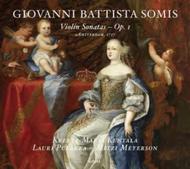
Giovanni Battista Somis - Violin Sonatas Op.1
£15.15
In stock - available for despatch within 1 working day
Despatch Information
This despatch estimate is based on information from both our own stock and the UK supplier's stock.
If ordering multiple items, we will aim to send everything together so the longest despatch estimate will apply to the complete order.
If you would rather receive certain items more quickly, please place them on a separate order.
If any unexpected delays occur, we will keep you informed of progress via email and not allow other items on the order to be held up.
If you would prefer to receive everything together regardless of any delay, please let us know via email.
Pre-orders will be despatched as close as possible to the release date.
Label: Glossa
Cat No: GCD921807
Format: CD
Number of Discs: 1
Genre: Chamber
Release Date: 2nd June 2014
Contents
Artists
Kreeta-Maria Kentala (violin)Lauri Pulakka (cello)
Mitzi Meyerson (harpsichord)
Works
Violin Sonatas (12), op.1Artists
Kreeta-Maria Kentala (violin)Lauri Pulakka (cello)
Mitzi Meyerson (harpsichord)
About
Mitzi Meyerson likes to come up with surprising musical finds or rediscoveries, and her latest - the Opera Prima of Giovanni Battista Somis - is as fascinating as her recordings devoted to Richard Jones and Gottlieb Muffat. Indeed, the harpsichordist chanced upon the score for this set of Baroque violin sonatas – first published in 1717 – when investigating the music of Richard Jones in the British Library, finding thereby another trove of forgotten Baroque gems.
Somis worked for the Dukes of Savoy, initially in Turin, in the early 18th century, but studied with Corelli in Rome. He later befriended Vivaldi, and taught many subsequent prominent violinists, including Jean-Marie Leclair. Known as a virtuoso on the violin himself (and he is said to have composed 152 violin concertos!), Somis even performed at the Concert Spirituel in Paris.
This, his first collection of sonatas, was dedicated to the powerful Regent of Savoy, Marie-Jeanne-Baptiste de Savoie, the mother of the future duke, Vittorio Amedeo II. The music is often very galant and perfectly combines Italian and French features.
Together with violinist Kreeta-Maria Kentala and cellist Lauri Pulakka, Meyerson fully enters into the Baroque spirit of transcribing and arranging on this Glossa recording, by varying these 12 three-movement sonatas with all the stylistic experience and insight that the modern-day musicians can offer.
--
The Europadisc Review
Today the name of Giovanni Battista Somis is barely known except to a few Baroque music aficionados, yet in his own time this Turin-born violinist and composer was held in high esteem. A close contemporary of Bach, Handel and Domenico Scarlatti, Somis (1686–1763) was a fellow student with Vivaldi in the early 1700s, later studying with Corelli in Rome, and counted Gaetano Pugnani and Jean-Marie Leclair the Elder among his many pupils. Born into a musical family, Somis spent most of his life based in his native Turin (capital of the Duchy of Savoy) in the service of the ruling family, and as he rose steadily through the Savoy musical establishment he also made at least one visit to Paris, where his playing aroused great interest and praise. ‘A single down-bow,’ wrote Hubert Le Blanc in 1740, ‘seemed like a stretched silken cord which … is surrounded with flowers, with silver festoons, with golden filigrees mixed with diamonds, rubies, garnets, and above all with pearls. One saw them spill out from his fingertips.’
Somis’s own music combines Italianate virtuosity and flair with French elegance: spirited, engaging and supremely tasteful. His surviving output includes five sets of sonatas for violin and continuo, the earliest of which (first printed in 1717 and reissued in 1725) is presented on this splendid new disc from Glossa. Violinist Kreeta-Maria Kentala, who plays a 1691 instrument by Giovanni Battista Rogeri, can actually trace her teaching lineage back to Somis, and she plays with a beautiful mixture of passion and poise, continually recalling Le Blanc’s description of Somis himself. She is joined by cellist Lauri Pulakka and harpsichordist Mitzi Meyerson, both of whom contribute booklet essays. Pulakka sets the music in its historic context, while Meyerson argues persuasively in favour of creative transcription in performance, justifying this with contemporary examples and quotes.
Accordingly, the performers not only indulge in tasteful ornamentation, but also vary the instrumentation and textures (with nicely deployed pizzicato passages, and even a special-effects bell!). All the sonatas are three-movement works, the first an Adagio followed by two fast movements, the last often in dance form. Yet such is the variety of the music itself, and so imaginative, witty and sensitive are the realisations, that these performances are a constant delight. This is music that easily stands comparison with the best of Somis’s more celebrated contemporaries. Try any of the opening movements to sample the poetry of these performers, and the finale of the sixth sonata (track 3) for some deft cello pizzicato. Best of all is the music-box interpretation of the eleventh sonata’s finale, which rounds off the disc in enchanting style.
Lovingly played and recorded, this marvellous disc deserves the highest recommendation. We must hope that this team will record more of Somis’s output, and soon!
Sound/Video
Paused
-
1Sonata no.3 in A minor - I. Adagio
-
2Sonata no.3 in A minor - II. Allegro
-
3Sonata no.3 in A minor - III. Allegro
-
4Sonata no.6 in D major - I. Adagio
-
5Sonata no.6 in D major - II. Allegro
-
6Sonata no.6 in D major - III. Allegro
-
7Sonata no.7 in E flat major - I. Adagio
-
8Sonata no.7 in E flat major - II. Allegro
-
9Sonata no.7 in E flat major - III. Presto
-
10Sonata no.10 in C major - I. Adagio
-
11Sonata no.10 in C major - II. Allegro
-
12Sonata no.10 in C major - III. Allegro
Error on this page? Let us know here
Need more information on this product? Click here