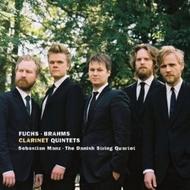
Fuchs / Brahms - Clarinet Quintets
£13.78
In stock - available for despatch within 1 working day
Despatch Information
This despatch estimate is based on information from both our own stock and the UK supplier's stock.
If ordering multiple items, we will aim to send everything together so the longest despatch estimate will apply to the complete order.
If you would rather receive certain items more quickly, please place them on a separate order.
If any unexpected delays occur, we will keep you informed of progress via email and not allow other items on the order to be held up.
If you would prefer to receive everything together regardless of any delay, please let us know via email.
Pre-orders will be despatched as close as possible to the release date.
Label: C-AVI
Cat No: AVI8553300
Format: CD
Number of Discs: 1
Genre: Chamber
Release Date: 28th April 2014
Contents
Artists
Sebastian Manz (clarinet)Danish String Quartet
Works
Clarinet Quintet in B minor, op.115Clarinet Quintet in E flat major, op.102
Artists
Sebastian Manz (clarinet)Danish String Quartet
About
On 15 October 1895, Johann Strauss Jr celebrated the 50th anniversary of his performing career. One of the first guests to arrive and pay his respects to the 'king of waltzes' was a great admirer, Johannes Brahms. Perhaps not just present to congratulate his fellow-composer, Brahms was certainly also interested in getting to hear a piece written specifically for the occasion: Robert Fuchs’ Serenade No.5, a witty, cheerful work containing some quotes from Strauss’s operetta 'Die Fledermaus'.
Fuchs attracted Brahms’ notice very early on. Brahms once praised him as "a splendid musician: everything is so fine and so skilful, so charmingly invented!". But Brahms was also aware of his younger colleague’s limitations. As other contemporaries remarked, Fuchs’ music was pleasant but often lacked dramatic effect. Born in 1847 as the youngest of thirteen children of a Styrian village schoolteacher, Fuchs’ lifelong reputation may even have suffered somewhat from the immediate success of his Serenade No.1 for Orchestra in 1874: from then on, everyone referred to him as the 'serenader fox'.
"Fuchs is never really profound”, Brahms remarked. Fuchs was nevertheless one of the rare composers in whom Brahms showed interest at all (as their common friend, the surgeon Theodor Billroth, noted). Moreover, Brahms energetically promoted Fuchs’ career. For instance, ”the extremely modest, timid and shy Fuchs had previously felt quite embarrassed” in negotiations with the Kistner publishing house, so Brahms put in a recommendation for him with Friedrich Simrock, his own publisher. Vienna musicologist Adalbert Grote also suspects that Brahms had a hand in Fuchs’s appointment as harmony professor at Vienna Conservatory. And since Fuchs led a rather precarious existence, Brahms helped him out financially as well.
Fuchs, like Brahms, treats the clarinet as first among equals. Connecting two main lyrical themes with a striking transitional motif, the first movement exudes a winning Viennese charm reminiscent of Schubert.
Error on this page? Let us know here
Need more information on this product? Click here