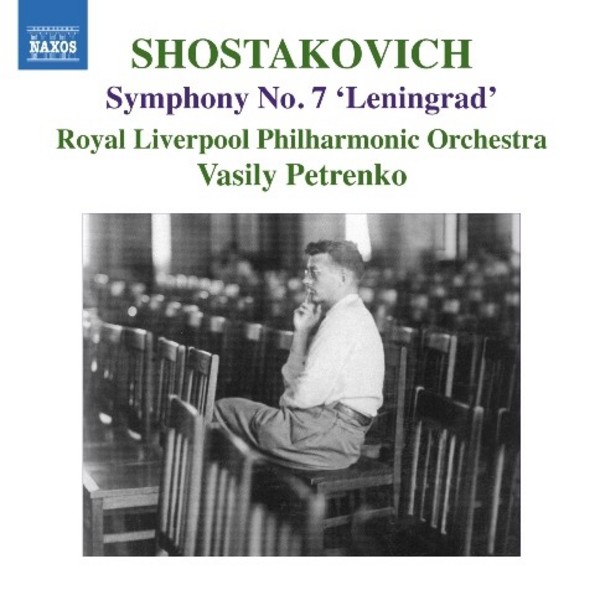
Shostakovich - Symphony No.7 ’Leningrad’
£12.30 £9.84
save £2.46 (20%)
special offer ending 25/01/2026
Currently out of stock at the UK suppliers. Available to order, but is likely to take longer than usual to despatch
Despatch Information
This despatch estimate is based on information from both our own stock and the UK supplier's stock.
If ordering multiple items, we will aim to send everything together so the longest despatch estimate will apply to the complete order.
If you would rather receive certain items more quickly, please place them on a separate order.
If any unexpected delays occur, we will keep you informed of progress via email and not allow other items on the order to be held up.
If you would prefer to receive everything together regardless of any delay, please let us know via email.
Pre-orders will be despatched as close as possible to the release date.
Label: Naxos
Cat No: 8573057
Format: CD
Number of Discs: 1
Genre: Orchestral
Release Date: 29th April 2013
Contents
Artists
Royal Liverpool Philharmonic OrchestraConductor
Vasily PetrenkoWorks
Symphony no.7 in C major, op.60 'Leningrad'Artists
Royal Liverpool Philharmonic OrchestraConductor
Vasily PetrenkoAbout
Three weeks after the Nazi invasion of the Soviet Union in June 1941, Shostakovich volunteered with the Home Guard in Leningrad. As the siege of the city intensified, he worked on his Seventh Symphony, completing three movements before being forced to leave Leningrad and travel east by train.
The work was completed in December that year. Initially he gave each movement a programmatic title, but later withdrew them, leaving this epic work as an emblem of heroic defiance in the face of conflict and crisis: ‘I dedicate my Seventh Symphony to our struggle against fascism, to our coming victory over the enemy, to my native city, Leningrad.’
Shostakovich’s epic Seventh Symphony is a study in defiance and survival, written largely in the ruins of the besieged city in 1941. Its reputation has fluctuated over the years, with its immediate post war reputation largely low. But in recent years it has taken its rightful place in Shostakovich’s symphonic canon.
The award-winning Royal Liverpool Philharmonic Orchestra is the UK’s oldest continuing professional symphony orchestra, dating from 1840. The dynamic young Russian Vasily Petrenko was appointed Principal Conductor of the orchestra in September 2006 and in September 2009 became Chief Conductor.
Sound/Video
Paused
-
1Symphony no.7 - I. Allegretto
-
2Symphony no.7 - II. Moderato (Poco Allegretto)
-
3Symphony no.7 - III. Adagio
-
4Symphony no.7 - IV. Allegro Non Troppo
Europadisc Review
As so often with works allegedly inspired by or describing a particular set of experiences, the best performances are those that demonstrate a thorough expressive commitment to the music itself, irrespective of any narrative, ethical or political subtext. And on these terms, Petrenko and his Liverpool players win hands down. They may lack the sheer tonal heft wielded by Bernstein in his famous Chicago recording for DG but, with speeds that are still measured without being over-indulgent, and aided by a warmly atmospheric recording in Liverpool's Philharmonic Hall, they home in unerringly on the Symphony's powerful expressive core.
The broad strides of work's opening are as expansive as one could wish. The RLPO brass, resplendent yet incisive, make their unmistakable mark in the steadily increasing tensions of the first movement's Boléro-like central section, and in the tutti eruptions of the remaining three movements. In the gently yearning second-movement intermezzo, the central 'trio' takes on a suitably threatening, neo-Mahlerian hue.
Yet it is above all in the Symphony's passages of quiet fragility, of tragic intimacy, that Petrenko and his orchestra really show their mettle. The latter stages of the first movement are exquisitely shaped, with the music allowed just the right degree of space and outstandingly sensitive playing from the strings and woodwind soloists. In the great Adagio, one marvels at the dynamic and expressive range, the piercing wind chording, the delicacy of the string playing and the eloquence of the violas' arioso in the penultimate section. The finale provides an thrilling conclusion: its early pages deftly played and electric with anticipation; the later moments of concentrated tenderness hitting home so that the eventual glowing 'victory' emerges even more powerfully for being harder won.
There are numerous recordings of this once scorned work in the catalogue, available both singly and as part of complete sets, but this latest account certainly matches up to the finest. As throughout this Naxos cycle, Petrenko and the RLPO strike an ideal balance between passionate involvement on the one hand, and accomplishment and poise of execution on the other, without ever compromising expressive immediacy. At bargain price, it's a clear top choice.

Error on this page? Let us know here
Need more information on this product? Click here