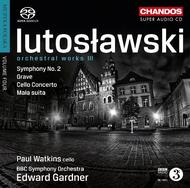
Lutoslawski - Orchestral Works Vol.3
£15.15 £9.09
save £6.06 (40%)
special offer ending 01/01/2026
In stock - available for despatch within 1 working day
Despatch Information
This despatch estimate is based on information from both our own stock and the UK supplier's stock.
If ordering multiple items, we will aim to send everything together so the longest despatch estimate will apply to the complete order.
If you would rather receive certain items more quickly, please place them on a separate order.
If any unexpected delays occur, we will keep you informed of progress via email and not allow other items on the order to be held up.
If you would prefer to receive everything together regardless of any delay, please let us know via email.
Pre-orders will be despatched as close as possible to the release date.
Label: Chandos
Cat No: CHSA5106
Format: Hybrid SACD
Number of Discs: 1
Genre: Orchestral
Release Date: 29th October 2012
Contents
Artists
Paul Watkins (cello)BBC Symphony Orchestra
Conductor
Edward GardnerWorks
Cello ConcertoGrave (version for cello and strings)
Little Suite (Mala suita)
Symphony no.2
Artists
Paul Watkins (cello)BBC Symphony Orchestra
Conductor
Edward GardnerAbout
Edward Gardner and the BBC Symphony Orchestra, described by Gramophone as a ‘veritable dream team’ in a review for Vol.1, are joined on this recording by the cellist and exclusive Chandos artist Paul Watkins.
Lutosławski drew his main thematic material for Little Suite (Mała suita) from folk melodies from the village of Machów in south-east Poland. As such he was following one of the paths recommended by the communist government for connecting to the ‘broad masses’ by creating what today might be called ‘people’s music’. In this work Lutosławski demonstrates his characteristic lightness of touch, excellent ear for orchestral timbre, and ability to transform his material into something highly individual.
The Second Symphony (1965-67) was Lutosławski’s first large-scale orchestral work since the Concerto for Orchestra (1950-54), and a lot had happened in Poland since the premiere of that work. The government had significantly eased its cultural restrictions for music, which meant that Polish composers were becoming increasingly exposed to new ideas from the West. Lutosławski, ever his own man, chartered a distinctive path through this thicket of new music, and by the mid-60s he had developed his own individual and expressive idiom. In the Second Symphony, he creates an atmosphere of tense anticipation in the opening stages, before drawing the listener into the ensuing, more purposefully developed music, which reaches a climactic explosion and resolution.
Paul Watkins is the soloist in the Cello Concerto, one of the most original works of recent times. While Lutosławski insisted that this highly dramatic work was a purely musical drama, Mstislav Rostropovich, its dedicatee, considered the music to be a mirror of his own battles with the authorities in the Soviet Union in the late 1960s and ’70s.
In Grave, for solo cello and strings, for the first time in his life (not counting folk-inspired pieces), Lutosławski based a work on the music of another composer: the first four notes of Debussy’s Pelléas et Mélisande. He takes Debussy’s motif and transforms it from intense musings into a free-flowing succession of robust and vigorous shapes.
Error on this page? Let us know here
Need more information on this product? Click here