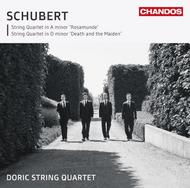
Schubert - String Quartets: Rosamunde & Death and the Maiden
£15.15 £12.88
save £2.27 (15%)
special offer ending 01/01/2026
In stock - available for despatch within 1 working day
Despatch Information
This despatch estimate is based on information from both our own stock and the UK supplier's stock.
If ordering multiple items, we will aim to send everything together so the longest despatch estimate will apply to the complete order.
If you would rather receive certain items more quickly, please place them on a separate order.
If any unexpected delays occur, we will keep you informed of progress via email and not allow other items on the order to be held up.
If you would prefer to receive everything together regardless of any delay, please let us know via email.
Pre-orders will be despatched as close as possible to the release date.
Label: Chandos
Cat No: CHAN10737
Format: CD
Number of Discs: 1
Genre: Chamber
Release Date: 3rd September 2012
Contents
Works
String Quartet no.13 in A minor, D804 'Rosamunde'String Quartet no.14 in D minor, D810 'Death and the Maiden'
Artists
Doric String QuartetWorks
String Quartet no.13 in A minor, D804 'Rosamunde'String Quartet no.14 in D minor, D810 'Death and the Maiden'
Artists
Doric String QuartetAbout
In March 1824, despite describing himself as ‘the most unhappy and wretched creature in the world’, Schubert completed not only the great Octet, but also the two String Quartets recorded here.
The String Quartet in D minor is considered the greatest of Schubert’s late quartets, mainly on account of its raw emotional honesty, which reaches an almost unendurable pitch in the second movement, a set of variations based on Schubert’s song Der Tod und das Mädchen. All four movements are driven by extensively repeated rhythmic figures, reminiscent of the musical style of Schubert’s great idol, Beethoven.
Full of Schubertian ambivalence, the String Quartet in A minor is a deeply intimate work. The opening, expressing brooding sadness, is played by the first violin over a restless accompaniment, and subsequently interrupted by flurries of almost manic energy. In the second movement, Schubert ‘borrowed’ the main melody from the second Entr’acte of his incidental music to the play Rosamunde, Fürstin von Zypern (1823) by Wilhelmine von Chézy.
Error on this page? Let us know here
Need more information on this product? Click here