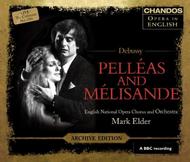
Debussy - Pelleas and Melisande
£19.90 £11.94
save £7.96 (40%)
special offer ending 01/01/2026
In stock - available for despatch within 1 working day
Despatch Information
This despatch estimate is based on information from both our own stock and the UK supplier's stock.
If ordering multiple items, we will aim to send everything together so the longest despatch estimate will apply to the complete order.
If you would rather receive certain items more quickly, please place them on a separate order.
If any unexpected delays occur, we will keep you informed of progress via email and not allow other items on the order to be held up.
If you would prefer to receive everything together regardless of any delay, please let us know via email.
Pre-orders will be despatched as close as possible to the release date.
Label: Chandos - Opera in English
Cat No: CHAN31773
Format: CD
Number of Discs: 3
Genre: Opera
Release Date: 3rd January 2012
Contents
Artists
Neil Howlett (baritone)Eilene Hannon (soprano)
Robert Dean (baritone)
Sarah Walker (mezzo-soprano)
John Tomlinson (bass)
Rosanne Brackenridge (soprano)
Sean Rea (bass)
English National Opera Orchestra and Chorus
Conductor
Mark ElderWorks
Pelleas et MelisandeArtists
Neil Howlett (baritone)Eilene Hannon (soprano)
Robert Dean (baritone)
Sarah Walker (mezzo-soprano)
John Tomlinson (bass)
Rosanne Brackenridge (soprano)
Sean Rea (bass)
English National Opera Orchestra and Chorus
Conductor
Mark ElderAbout
It is not so much the extremity of emotions in opera that moves us, but their intensity. And intense emotion does not need to be loud, or dramatic. It can be quiet, deep and profound, as in this operatic masterpiece, based on Maeterlinck’s symbolist drama. With its simple setting of every day words, and slow-burning passion, the opera emerged in the early twentieth century as the very antithesis to the Wagnerian style. In the words of Debussy himself: ‘I imagine a kind of drama quite different from Wagner’s in which music would begin where the words are powerless as an expressive force. Music is made for the inexpressible.’
Debussy purposely avoided elaborate and lyrical language, and wrote in the simplest prose. In fact, most of the characters speak to one another in plain speech, and everything they say is, on the surface, completely transparent. But the waters run deep, and as questions bring about either the wrong reply or no reply at all, the simple language only deepens the obscurity of what is actually being said.
The plot is based on a tragic love triangle. Prince Golaud finds a mysterious young woman, Mélisande, lost in a forest. He marries her and brings her back to the castle of his grandfather, King Arkel of Allemonde. Here Mélisande becomes increasingly attached to Golaud’s half-brother, Pelléas, arousing Golaud’s jealousy. Golaud goes to excessive lengths to find out the truth about the relationship and Pelléas eventually decides to leave the castle, but he arranges to meet Mélisande one last time and the two finally confess their love for each other. Golaud, who has been eavesdropping, rushes out and kills Pelléas. Not long after, having given birth to a daughter, and with Golaud still begging her to tell him ‘the truth’, Mélisande dies.
Error on this page? Let us know here
Need more information on this product? Click here